Homeschool Reading, Writing, and Math Strategies for Learning Disabilities
Teaching Reading, Writing, And Math At Home – Practical Strategies That Work For Kids With Learning Disabilities
Families begin homeschooling for many reasons. But for parents raising children with learning disabilities, the journey often comes from a place of urgency and hope. They want to help their child succeed without shame. They want schoolwork to feel possible again. They want to reduce the frustration that comes when a child tries hard but still struggles.
Learning disabilities can affect how the brain processes language, numbers, writing, attention, or memory. They do not define intelligence or potential. When instruction shifts to a method tailored to how the child learns, progress finally becomes visible. Confidence returns. Skills strengthen.
This guide gives families practical tools to teach reading, writing, and math at home through supportive structures, step-by-step skill development, and academic interventions that work.
Homeschooling can give children with learning disabilities what many classrooms cannot: time, patience, customization, and celebration of every win.
Understanding Learning Disabilities: Why Progress May Feel Slow
Children with learning disabilities are often misunderstood. They may be labeled as not trying hard enough, disinterested in school, distracted, or behind their peers due to a perceived lack of effort. In reality, these children are often working harder than anyone realizes. Their brains simply process information differently, and their strengths are very much present—they’re just hidden beneath barriers that haven’t yet been removed.
Some of the most common academic challenges include:
Reading Disabilities (such as dyslexia)
- Difficulty decoding or blending sounds
- Slow reading fluency
- Trouble remembering phonics rules
- Hesitation or avoidance of reading tasks
Writing Disabilities (such as dysgraphia)
- Struggles with handwriting
- Difficulty organizing thoughts
- Weak spelling skills
- Frustration during written assignments
Math Disabilities (such as dyscalculia)
- Difficulty with number sense
- Problem-solving confusion
- Trouble memorizing math facts
- Lack of understanding of place value
Academic difficulty is not a measure of intelligence — it is a sign that teaching must change.
The Three Pillars of Homeschooling With Learning Disabilities
A successful homeschool plan contains explicit instruction, multisensory learning, and daily repetition with positive reinforcement
Children thrive with routines that reduce stress and highlight their strengths. When lessons include visual, auditory, and tactile elements, the brain forms stronger learning connections.
Progress becomes a ladder that children climb one small step at a time — not a race against peers.
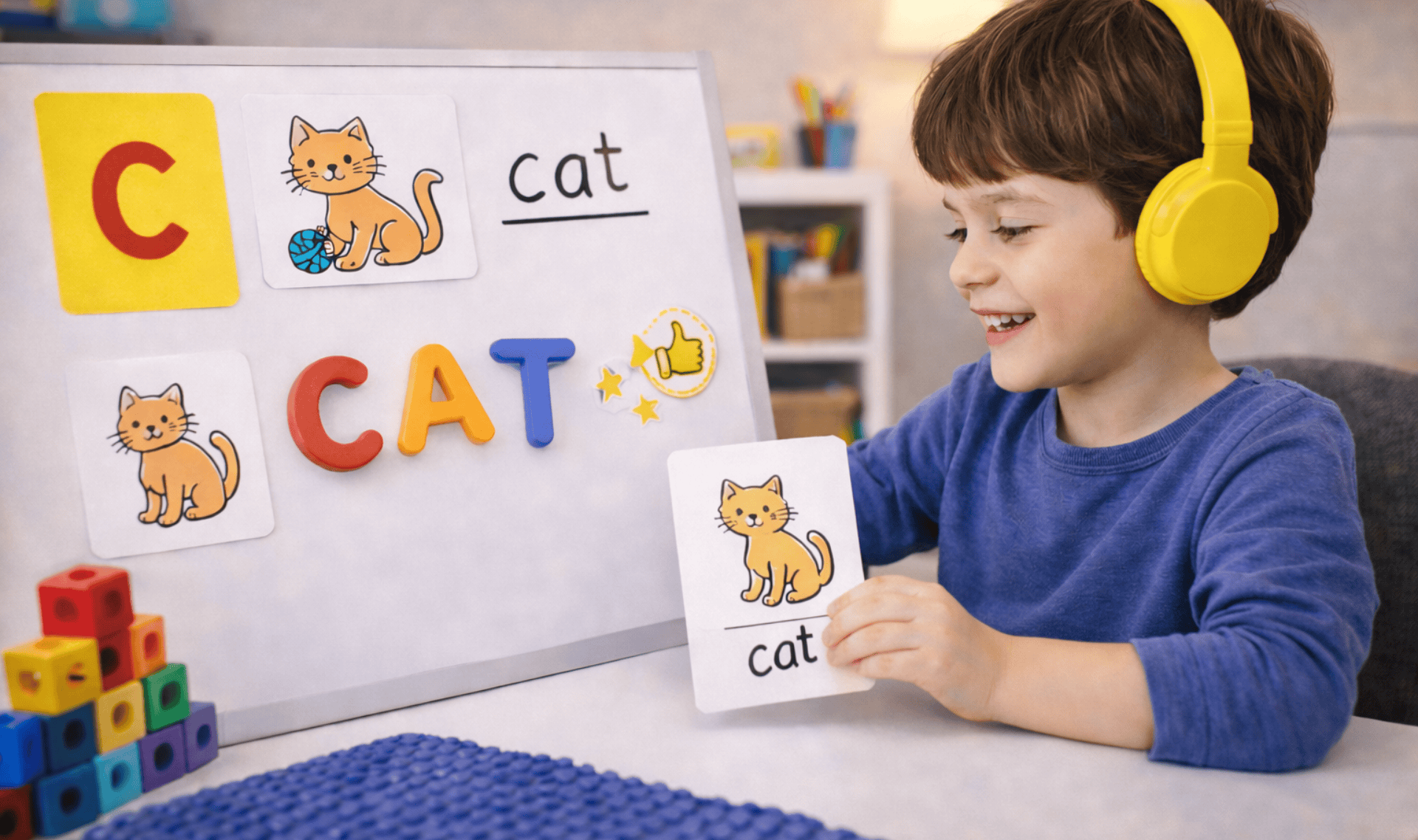
Homeschool Reading Strategies: Helping Words Make Sense
Reading is a complex skill that demands decoding, fluency, and comprehension. For struggling students, missing one layer can collapse the foundation.
A strong reading program uses:
- Systematic phonics instruction
- Repetition that helps build automaticity
- Decodable books aligned to current skills
- Fluency practice through short, engaging texts
- Direct instruction in comprehension strategies
The Skill-Building Path for Reading
| Step | Skill Targeted | Examples |
| 1 | Phonological awareness | Rhyming, segmenting sounds, blending syllables |
| 2 | Phonics mastery | Teaching each letter-sound correspondence explicitly |
| 3 | Sound blending | Tap, slide, or stretch sounds to form words |
| 4 | Decodable reading | Simple, controlled texts to grow confidence |
| 5 | Fluency | Timed short readings, echo reading, paired reading |
| 6 | Comprehension | Ask “who, what, when, where, why, how” questions |
One success leads to another — decoding builds fluency, fluency enables comprehension, and comprehension creates enjoyment.
For students needing intensified support, specialized tutors can remove roadblocks and accelerate growth by focusing on root learning challenges.
Reading is never hopeless — it simply needs the right support.
Homeschool Writing Strategies: Turning Ideas Into Words
Writing combines many demanding skills:
- Motor planning
- Spelling
- Grammar
- Organization of ideas
- Memory retrieval
Children with writing disabilities often have great ideas — the challenge is getting those ideas onto the page.
Core principles of writing success:
- Reduce physical strain
- Provide structure for ideas
- Celebrate communication before perfection
The Writing Scaffold Ladder
| Level | Main Goal | Strategy Example |
| Foundation | Handwriting comfort and legibility | Pencil grips, finger spacing tools |
| Level 1 | Sentence structure clarity | Fill-in-the-blank starters, sentence puzzles |
| Level 2 | Expanding ideas | Who-What-Where-When-Why visual prompts |
| Level 3 | Organization | Graphic organizers for paragraphs |
| Level 4 | Spelling improvement | Multisensory phonics and word patterns |
| Level 5 | Independent writing | Short timed writes with support faded gradually |
The key: writing does not begin with essays — it begins with one supported sentence.
Using voice-to-text for drafting can also relieve pressure, allowing ideas to flow freely while handwriting skills improve separately.
Gradual release builds independence without fear.
Homeschool Math Strategies: Making Numbers Understandable
Math often becomes overwhelming when students can’t visualize number relationships, when concepts remain abstract instead of concrete, or when tasks require quick recall without true understanding. These challenges can create confusion and frustration, especially for learners with disabilities.
Homeschool math instruction offers the opportunity to replace that confusion with clarity. Effective approaches begin with concrete manipulatives before moving to paper-based tasks, along with step-by-step modeling that makes problem-solving visible and accessible. Visual supports help reduce cognitive load, while real-world connections increase relevance and engagement. Frequent review ensures concepts are secure before introducing new material, allowing students to build confidence alongside understanding.

Math Skill Progression Chart
| Stage | Focus | Support Tool |
| Stage 1 | Number sense | Counting objects, number lines, ten frames |
| Stage 2 | Operations | Blocks, linking cubes, bead strings |
| Stage 3 | Place value | Base-10 blocks, expanded form visuals |
| Stage 4 | Fact fluency | Games, skip counting, strategy-based memorization |
| Stage 5 | Problem solving | Graphic organizers, think-aloud modeling |
Hands-on learning helps students see math — not just memorize it.
Why Multisensory Instruction Works Better At Home
Children with learning disabilities often rely on multisensory cues to transform abstract information into something their brains can store and retrieve more easily. When multiple learning pathways are activated at once, understanding becomes more durable and accessible.
Effective strategies might include tapping out sounds while decoding words, writing letters or words in sand or shaving cream, using colored markers to support math regrouping, acting out vocabulary terms, or singing mnemonic songs. These approaches strengthen memory while reducing frustration. Home learning environments are especially well suited for this kind of creativity, allowing for movement, flexibility, and individualized pacing that supports deeper, more meaningful learning.
Executive Function: The Hidden Skill Set Behind Learning Success
Executive function skills help children:
- Plan
- Organize
- Stay focused
- Start tasks
- Control impulses
- Manage time
Weak executive function makes learning extremely hard — no matter how smart a child is.
Ways to support executive function at home:
- Visual checklists for schoolwork
- Color-coded materials
- Timers to show task duration
- Step-by-step breakdowns of assignments
- Predictable routines for each subject
Celebrating progress encourages the brain to try again.
Building Confidence Through Positive Reinforcement
Children who struggle academically often begin to internalize self-doubt, leading them to avoid tasks they associate with failure. Positive reinforcement helps rewrite that narrative by shifting the focus from outcomes to growth. When recognition highlights effort, strategy use, persistence, participation, and small successes, children learn that progress—not perfection—is what matters.
Simple affirmations like “You kept going even when it was tough” or “You used the new strategy and it worked” reinforce resilience and self-belief. When progress is acknowledged every single day, confidence grows—and confidence is the fuel that keeps learning moving forward.
The Power Of Patience: Why Slow Growth Still Counts
Learning disabilities do not disappear overnight. Improvement happens gradually.
When parents measure success by:
- Reduced frustration
- Increased willingness
- Stronger stamina
- More independence
- Daily skill gains
They see the truth: Slow progress is still progress — and meaningful progress.
When Families Need Backup: Homeschool Support That Moves The Needle
Managing academics while supporting emotional regulation can be overwhelming. Families deserve expert partnership — not pressure to handle everything alone.
Professional homeschool support can:
-
Identify specific learning gaps
-
Provide personalized instruction
-
Create systems that reduce frustration
-
Track and report real growth
-
Bring relief to both child and parent
Partnership transforms overwhelm into momentum.
A Flexible Sample Day For Homeschool Success
Morning Warm-Up
- Sensory and movement warm-up
- Short reading lesson aligned to skill level
- Immediate praise for effort
Midday Work
- Writing practice using scaffolds
- Break for movement, snacks, and calming activities
- Math lesson with manipulatives
Afternoon
- Hands-on project: cooking, building, gardening, crafts
- Review successes from the day
- Preview tomorrow to reduce anxiety
This routine brings steadiness without pressure.

Skill Gains Parents Can Expect Over Time
As the right supports begin to take hold, parents often notice meaningful changes. Decoding and comprehension improve, spelling and writing become more organized, and number sense and problem-solving skills grow stronger. Academic time is marked by fewer meltdowns and increased emotional regulation, while children gradually gain more independence with their assignments. As learning starts to feel possible again, hope naturally grows.
Final Thoughts: Every Child Can Learn With The Right Tools
Learning disabilities are challenges — not limitations. Children grow academically when instruction honors their learning style, strengthens their confidence, and supports their emotional needs.
Homeschooling allows parents to redesign learning, remove shame, highlight strengths, rebuild trust in education, and celebrate victories that were overlooked in school
With the right tools and specialized guidance, every child can make meaningful gains in reading, make meaningful gains in reading, writing, and math.
Success is not measured by perfection.
Success is measured by progress — one proud step at a time.